
Martin Margiela
Martin Margiela is a Belgian designer and artist who founded the French fashion house Maison Martin Margiela. He is a legend in the fashion world, recognised for his mystique, critique of the fashion system, and visionary concepts.

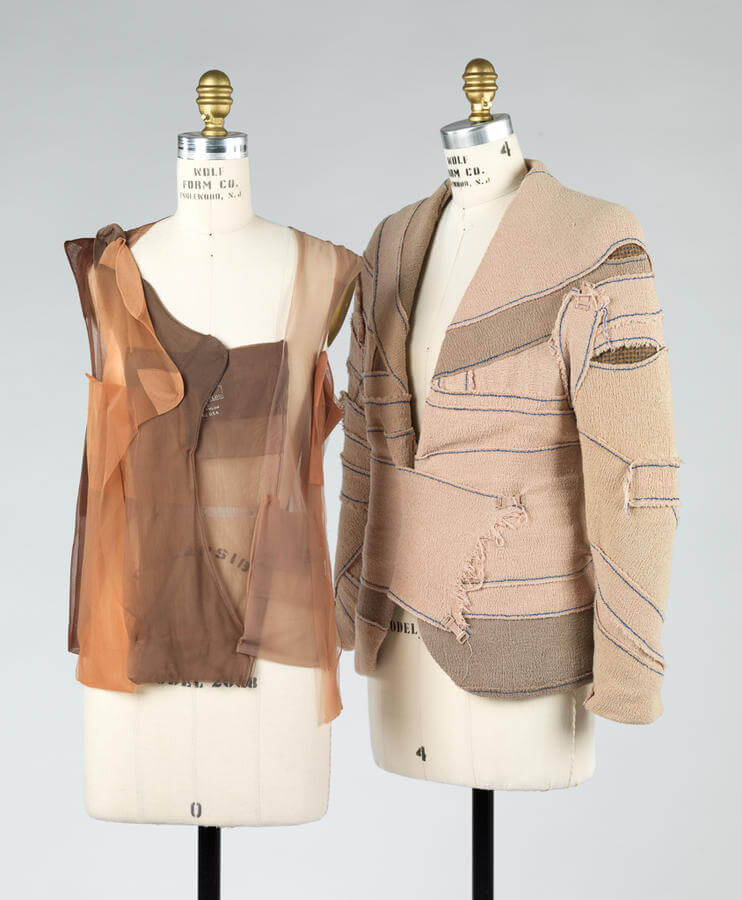
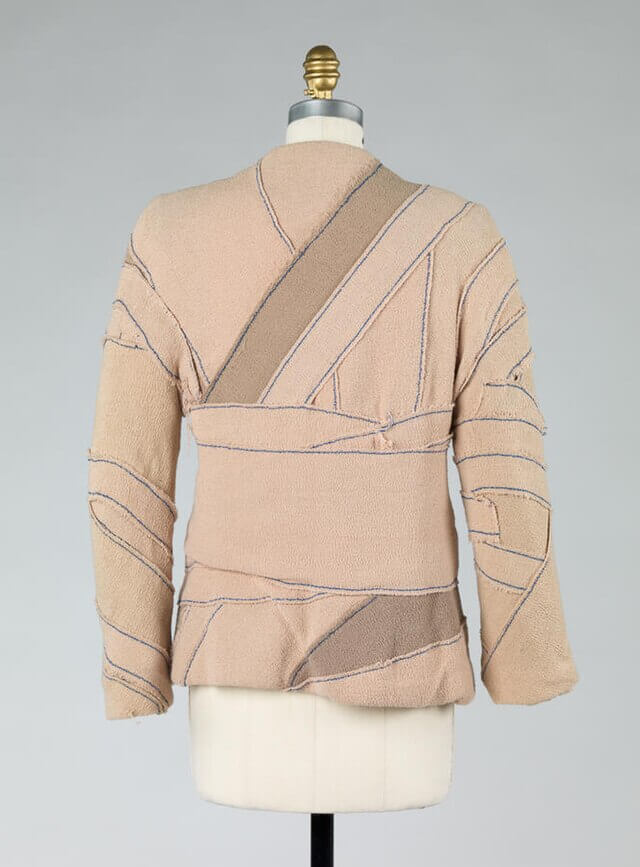
Martin Margiela was born on 9 April 1957 in Genk, Belgium. His father was a hairdresser, and his grandmother was a seamstress, and he often observed their work with fascination. TV programmes about Parisian designers made a great impression on Margiela and inspired his dream of becoming a designer in Paris.
As a young man, he studied at Sint-Lukas Art High School in Hasselt, Belgium, before enrolling in the fashion programme at the Royal Academy of Fine Arts in Antwerp, Belgium, in 1977.
After graduating from the academy in 1979, he worked as an independent designer in Italy and Belgium for five years. Margiela then moved to Paris in 1984 to work as an assistant to Jean Paul Gaultier. From the start, Gaultier believed Margiela was ready to launch his own label, but Margiela insisted on assisting Gaultier to gain insight into running a fashion house. In 1987, he left Jean Paul Gaultier, feeling ready to fulfil his dream of being a designer in Paris, and in 1988 he established the fashion house Maison Martin Margiela.
Philosophy
The fashion studios of the 1980s were concrete grey, which Margiela felt was not suitable for his universe. For this reason, he painted everything in his studio white, like a laboratory or a blank canvas. The staff wore white coats: “blousons blanche,” which means white jackets.
The colour white is central to Margiela’s world. It is neutral and without identity. Margiela disliked consumers buying clothes based on brand or designer. Therefore, for a long time, Margiela’s label was plain, featuring only four white stitches visible on the outside. More recently, the label consists of the numbers 0–23, but still with the four stitches on the back.
Margiela had no intention of seeking fame; rather, he saw anonymity as essential to his work. The art was to speak for itself. Models often had their faces covered to reinforce the sense of anonymity. He felt that he could deliver more while protected from the outside world. For this reason, he never appeared publicly, not even at his shows. There are very few photos and interviews of him. Communication with Margiela took place via fax or email. He is truly like the colour white: without identity.
Despite his desire for anonymity, and before gaining fame for his own brand, Margiela was seen on the catwalk at Jean Paul Gaultier’s Fall/Winter 1986 “Russian Constructivist” show. This was one of the few occasions he appeared in public.
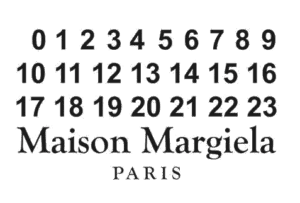
The numbers 0–23 on the label indicate which line the particular garment belongs to. The relevant number is circled:
0: Artisanal collection for men and women
1: Women’s collection
3: Perfumes
4: Basics for women (wardrobe for women)
6: MM6, lower-priced and more accessible for all genders
8: Eyewear
10: Men’s collection
11: Accessories
12: Fine jewellery
13: Objects and publications
14: Basics for men (wardrobe for men)
22: Footwear
Artisanal Line 0
Artisanal means handmade and is line 0, which was introduced in 2006. Each garment is handmade in Paris and consists of recycled items and materials. There is a greater focus on artistic craftsmanship rather than creating commercial products. In 2012, the Artisanal line became an official member of the Chambre Syndicale de la Haute Couture, which means the line is classified as Haute Couture.
Deconstructionist
Margiela was upcycling clothes before it became popular. He would source garments from charity shops and flea markets, then assemble them in artistic ways. Military socks became a sweater, and gloves were transformed into a top.
He introduced a raw aesthetic to the otherwise glamorous fashion world. Characteristic features of the clothing included exposed seams, frayed stitching, and garments turned inside out. He liked the clothes to look as if the model had put them together themselves. This gave insight into what the clothes were made of and how they were constructed. He showcased the beauty in imperfection and blurred the line between luxury and waste.
Margiela’s methods were unconventional. Models were street-cast before it was common, and shows were held in unusual locations such as a cemetery, a car park, and a train station.
In 1989, Margiela held what he called the most magical show of his career. In Paris’s 20th arrondissement, in a North African neighbourhood, a playground was used as the catwalk. Invitations to the show were drawn by local children. Among the audience were locals in the front row, with the press behind them. Margiela’s models were instructed to walk less professionally and more like boys. The models stumbled on the uneven terrain while the children ran amongst them. It was revolutionary for the extravagant industry.
Tabis
In 1992, the “Tabi” was launched – a shoe model inspired by traditional Japanese socks. The big toe is separated from the other toes, and the shoe’s toe resembles a cow’s hoof. The “Tabi” was originally introduced as a high-heeled shoe but is now available in various styles, colours, and materials. It remains one of Margiela’s most iconic designs.

Orange is the new white
In 1997, Margiela was appointed Creative Director at Hermès — an unconventional, avant-garde designer at a traditional fashion house. Despite expectations that he would destroy the iconic “Kelly” bag, Margiela’s time at Hermès was down-to-earth. The clothing was inspired by 1920s sportswear and leisurewear, with a focus on simplicity and quality. Iconic Hermès patterns and illustrations were downplayed to let the designs speak for themselves rather than the brand. The monochromatic colours and emphasis on craftsmanship created a timeless quiet luxury. Margiela left Hermès in 2003 and was succeeded by his former mentor, Jean Paul Gaultier.
What now?
After 20 years at Maison Martin Margiela, Margiela left fashion in 2009. For five years, the house had no creative director until John Galliano joined in 2014 and rebranded it as “Maison Margiela.”
Today, Martin Margiela enjoys creating paintings, sculptures, and other forms of visual art. He does this whenever he feels inspired, without the strict deadlines of the fashion industry.