
Understand Colours
Colour theory explains how colours work together and provides an understanding of how we perceive them both visually and psychologically. It can be used to create harmonious or contrasting colour combinations and to communicate a desired message.
This article is based on the RYB colour wheel — Red, Yellow & Blue — as it offers the best artistic understanding of colour. This wheel contains 12 different colours.
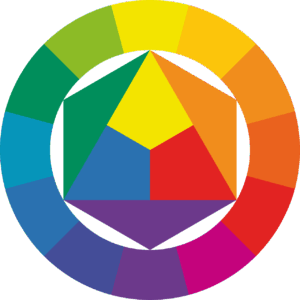
The three core colours are the primary colours: red, yellow, and blue — which cannot be created by mixing other colours.
Next are the secondary colours, which are created by mixing two primary colours: blue + yellow = green, blue + red = purple, red + yellow = orange.
The tertiary colours are the remaining six and are made by mixing a primary colour with a secondary colour. These are red-orange, yellow-orange, yellow-green, blue-green, blue-purple, and red-purple.
Colours can also be divided into warm and cool tones. On the colour wheel, warm colours are found between yellow and red-purple, while cool colours are between purple and yellow-green. Warm colours radiate energy, while cool colours convey calmness.
A colour in its purest form is called a saturated colour or a hue. All the colours in the wheel mentioned above are hues.
You can create a broken colour by mixing a saturated colour with black, white, grey, or its complementary colour. This turns it into a desaturated colour, reduces its intensity, and makes it appear more natural. In colour theory, we distinguish between shade, tint, tone, and neutralization.
Shade
A shade is created when a saturated colour is mixed with black. This makes the colour darker and deeper.
Tint
A tint is created when a saturated colour is mixed with white. These colours are also known as pastel colours.
Tone
A tone is created when a saturated colour is mixed with grey. This makes the colour appear more muted or dusty.
Neutralization
Neutralization is when a saturated colour is mixed with its complementary colour. This makes it appear more earthy, natural, or “muddy”.
Colour combinations
Complementary colours are two colours that sit opposite each other on the colour wheel — for example, blue and orange, or red and green. These colours contrast with one another and bring out the best in each other.
Split-complementary colours consist of three colours positioned across the colour wheel: one base colour and two colours on either side of its complementary colour. For example, if blue is the base, its split-complementary colours would be red-orange and yellow-orange.
Analogous colours are colours that sit next to each other on the colour wheel — for example, blue, blue-purple, and blue-green. These colours share a common base hue and have a harmonious transition between them. Choose one dominant colour and use the other two as accent colours.
Triadic colours are three different colours evenly spaced around the colour wheel. The three colours form a triangle with 120 degrees between each. This colour scheme is energetic and provides both contrast and balance.
Tetradic colours are four different colours evenly spaced around the colour wheel. The four colours form a rectangle with 90 degrees between each pair. This creates two pairs of complementary colours, resulting in a rich and complex contrast. For example, blue and orange combined with red and green.
Monochromatic means “single-coloured” and refers to combining different shades, tints, and tones of the same colour.
Colour symbolism
| Colour | Psychological effect | Symbolism |
|---|---|---|
| Red | Energetic, passion, dominant, anger, and dangerous | Warning, romance, eroticism, war, and blood |
| Yellow | Creative, attention-grabbing, optimistic, and restless | Warning, deceit, sun, vitality, and joy |
| Green | Natural, balanced, harmonious, and fresh | Hope, growth, environment, health, money, envy, and youth |
| Blue | Calming, logical, reliable, and melancholic | Calm, stability, intelligence, wisdom, and water |
| Purple | Mysterious, dramatic, and royal | Luxury, power, and spirituality |
| Pink | Feminine, loving, youthful, and playful | Empowerment, innocence, care, and gentleness |
| Orange | Energetic, happy, and warm | Fire, friendliness, and humour |
| Brown | Natural, calm, and comfortable | Earth and stability |
| Black | Mysterious, eerie, sophisticated, and dominant | Evil, death, luxury, modernity, and minimalism |
| White | Elegant, pure, and simplicity | Innocence, peace, modernity, and minimalism |
| Grey | Dull, old, and sturdy | Sadness, time, age, modernity, and minimalism |
Colour | Psychological effect | Symbolism |
Red | Energetic, passion, dominant, anger, and dangerous | Warning, romance, eroticism, war, and blood |
Yellow | Creative, attention-grabbing, optimistic, and restless | Warning, deceit, sun, vitality, and joy |
Green | Natural, balanced, harmonious, and fresh | Hope, growth, environment, health, money, envy, and youth |
Blue | Calming, logical, reliable, and melancholic | Calm, stability, intelligence, wisdom, and water |
Purple | Mysterious, dramatic, and royal | Luxury, power, and spirituality |
Pink | Feminine, loving, youthful, and playful | Empowerment, innocence, care, and gentleness |
Orange | Energetic, happy, and warm | Fire, friendliness, and humour |
Brown | Natural, calm, and comfortable | Earth and stability |
Black | Mysterious, eerie, sophisticated, and dominant | Evil, death, luxury, modernity, and minimalism |
White | Elegant, pure, and simplicity | Innocence, peace, modernity, and minimalism |
Grey | Dull, old, and sturdy | Sadness, time, age, modernity, and minimalism |
Colour terms
Luminance
Luminance defines the brightness of colours. Colours like white and yellow have high luminance, while colours like black and purple have low luminance. In other words, it refers to whether a colour is light or dark.
Iridescence
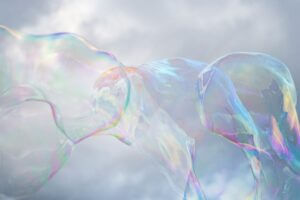
Iridescence is a surface that changes colour depending on the angle. It shows shimmering colours, much like a rainbow, due to the way light hits it. Iridescence can be seen, for example, on soap bubbles, mother-of-pearl, and fish scales.
Fluorescence
Something fluorescent describes an object that glows under UV light. This can be seen, for example, in safety vests, traffic signs, and highlighters.
Phosphorescence
Something phosphorescent describes an object that glows on its own after being exposed to UV light or normal light. This glow can last anywhere from a few minutes to several hours.
Metallic
Metallic colours are colours that imitate the appearance of different metals. There are three types of metal finishes: chrome, glossy, and matte.
Chrome is reflective like a polished mirror, glossy reflects light but has an unpolished surface, and matte is dull and does not reflect.
Multicoloured
Multicoloured describes something that consists of many different colours.
Colour-blocking
Colour-blocking is a style technique that uses “blocks” of different saturated colours without patterns. It involves contrasting complementary colours placed next to each other. For example, blue trousers paired with an orange jumper.
