
Muslim clothing
Clothing can be used to show one’s religious beliefs or cultural affiliation. Common for Muslim clothing is that it is meant to express modesty, humility, and respect toward the divine.
It is not tight-fitting or transparent, and it must not resemble the clothing of the opposite sex. The clothing should be clean and is not worn to express pride or provocation.
The clothing must cover the “awrah” — which refers to intimate parts of the body. For men, this is from the navel to the knees, and for women, it is the entire body except the face and hands. The purpose of covering women more extensively is to focus on their character rather than judging their appearance or sexualizing them.
Head coverings are not seen as a symbol of oppression, but as an expression of religious identity. Many Muslim women do not wear head coverings but still consider themselves believers.
Women's clothing
Hijab means “barrier” in Arabic. As head covering, it is understood as a barrier between people, for protection, modesty, and privacy. It is a scarf that covers the hair, ears, neck, and often one or both shoulders, but leaves the face exposed.

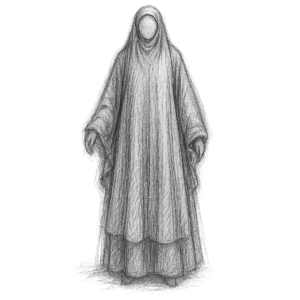
Khimar means “covering” in Arabic. It is more covering than the hijab, as the khimar also falls over both shoulders, chest, and back. A long khimar can reach down to the knees. It is not a traditional scarf but a garment sewn as a fixed piece that is put on over the head like a cape.
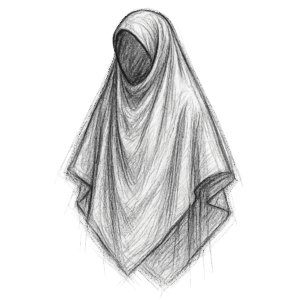
Niqab means “face veil” in Arabic, and is related to na-qa-ba, which means “to bore a hole.” It is a piece of fabric that covers the face and neck but has an opening for the eyes. A niqab is combined with other garments so that the rest of the body is covered.

Burka means “covering” in Arabic. It is a garment that covers the entire body from head to toe. The whole face is covered, but there is a sewn fabric mesh in front of the eyes that allows the woman to see while preventing others from seeing in.
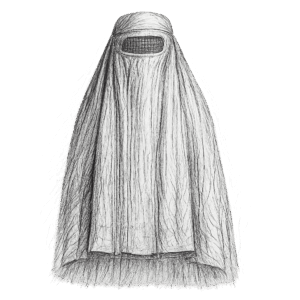
Chador means “tent” in Persian. It is a large piece of fabric without sleeves or buttons, draped over the head and covering from head to foot. It is held in place with hands, arms, or clips. However, a chador requires additional head covering to cover the hair and possibly the face.

Abaya means “cloak” in Arabic. It is a long, robe-like dress with long, wide sleeves. Often, an abaya is elegant and decorated for special occasions. It is combined with head covering and can be worn closed or open, with other clothing underneath.
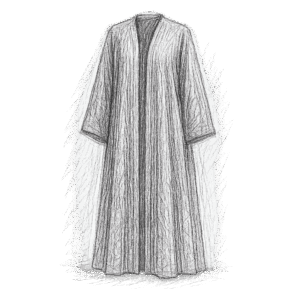
Jilbab is very similar to an abaya. It is a long, closed garment that covers the whole body. It is combined with head covering like an abaya but differs by being simpler and more conservative. Both fulfill the requirement of covering, but the jilbab is directly related to the Quran.
Often, women also wear gloves to cover themselves further.
Men's clothing
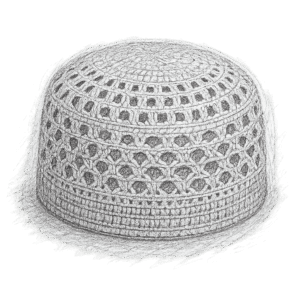
A Kufi is a hat worn by Muslim men. It is especially worn during prayer but also as everyday attire. The hat is cylindrical and has no brim. A kufi can also be crocheted, giving it a dome shape.

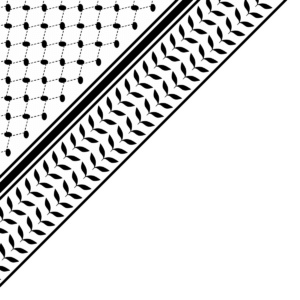
A Keffiyeh is a neck and head scarf worn by men. It can be recognized by its pattern: a fishnet pattern symbolizing the sea, broad lines symbolizing historic trade routes, and olive leaves due to cultural significance (especially for Palestinians), symbolizing endurance. The black-and-white keffiyeh is associated with Palestine, while the red-and-white keffiyeh is associated with Jordan.

A Thobe is a long-sleeved garment for men that extends from the neck to the ankles. It is loose-fitting and usually solid-coloured. It comes both with and without a collar and has a button opening down to the chest or navel.

A Bisht is a cloak for men worn over a thobe. It is used on formal occasions and is often associated with prestige and respected positions, such as religious leaders. A bisht typically features zari embroidery of gold threads along the edges.

Aesthetic Flexibility
Depending on the occasion and personal preference, the clothing is worn in different colours and fabrics. Often, the clothing is adorned with embroidery and other details for festive occasions. The colours green, black, and white hold special religious significance:
- Green is associated with paradise, nature, and the Prophet Muhammad.
- Black is associated with modesty and sanctity.
- White is associated with purity and faith, and was recommended by Muhammad to be worn.