
denim
Denim is a cotton-based textile. It is one of the most popular fabrics in the world, as it is durable, comfortable, and versatile. It is mostly used for jeans, but also for everything from jackets and shirts to hats and shoes.

Traditional denim is a natural textile made from 100% cotton and dyed with authentic indigo, which gives it a deep blue colour. Modern variations combine cotton with synthetic fibers such as spandex to make the fabric stretchable and are available in a wide range of colours. A defining feature of all types of denim is the fabric’s durable weave.
In weaving, there are two directions of threads: the warp, which runs vertically along the length of the fabric, and the weft, which runs horizontally. A fabric’s pattern depends on how the warp and weft threads pass over and under each other. Denim’s pattern is characterized by its diagonal lines, created by twill weaving.
Twill weaving occurs when the weft passes over one or more warp threads and then under two or more warp threads. Each row is offset from the previous one, creating the diagonal pattern.
When the weft goes over the same number of warp threads as it goes under, it is called a balanced twill weave. In this case, the warp and weft threads appear equally on both sides of the fabric.
2x2 Twill weave (2 under 2 over)
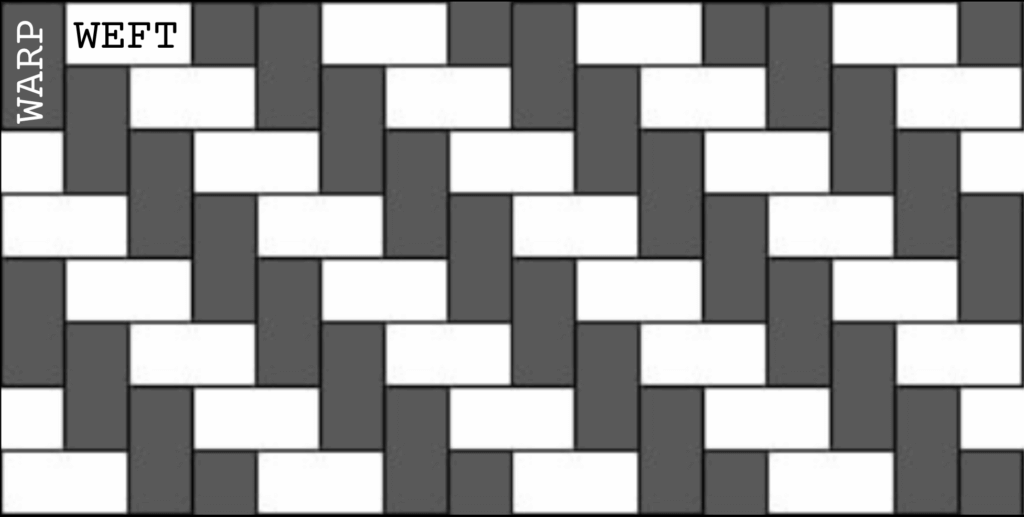
When the weft passes over a different number of threads than it goes under, it is called an unbalanced twill weave. This means that one side of the fabric will be dominated by the warp, while the other side will be dominated by the weft.
3x1 Twill weave (3 under 1 over)

Denims colour
Denim typically consists of an unbalanced twill weave. The warp is dyed, while the weft is left neutral. This is why the colour of denim is more prominent on one side of the fabric and lighter on the other.
The blue colour is characteristic of denim and comes from the pigment indigo, which is extracted from indigo plants. Indigo means “the colour from India,” and as the name suggests, the plant originates from India, where it has been used for textile dyeing for the past 5,000 years. Natural indigo is one of the few organic blue dyes that can be used for textiles.
In 1878, synthetic indigo was invented as the world’s first artificial dye pigment. Within a few decades, the use of natural indigo was almost entirely replaced by synthetic indigo. This is because synthetic indigo is cheaper, produces less variation in colour, and is considered the sustainable alternative — despite being petroleum-based.